8171 Fake SMS Alert 2026: How to Identify Fake BISP Messages & Avoid Scams
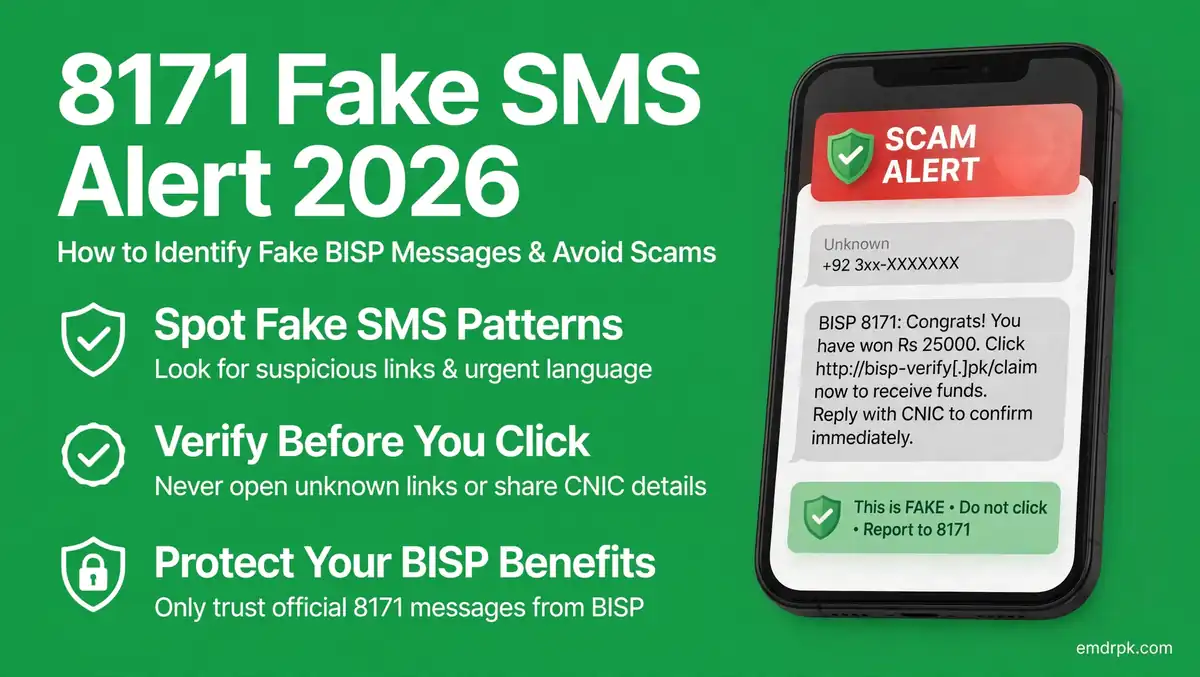
A text arrives on your phone: Your BISP payment of Rs 25,000 is approved. Click the link to collect. It looks official, it mentions BISP 8171, and your family really does need the money. This is exactly how scammers work, and it is why BISP keeps issuing warnings. This 8171 fake SMS alert 2026 guide explains how to tell a real BISP message from a fake one, what the scammers want, and what to do if you have already replied or clicked.
Why Scammers Use the BISP Name
Millions of families wait for BISP payments, so a message about “your payment” gets attention fast. Scammers copy the language and the 8171 number to steal CNICs, OTPs, and wallet balances. BISP has also been warning the public. The Nation reported on 24 October 2026 that BISP cautioned citizens against fraudulent messages circulating on social media and through mobile phone numbers. The same report says BISP warned that fake messages often claim that stipends have been approved, request contact details to transfer money, or promise enrolment in the programme. 8171 Web Portal Online
The One Rule That Covers Most Cases
BISP states that all official messages are sent only from 8171. The Nation report puts it this way: all official messages are sent exclusively from the number 8171, while messages received from other numbers should be treated as fake. Another guide says this policy was repeated in BISP’s March 2026 press release.
So if a message about BISP comes from an ordinary 03xx mobile number, a long number, or any code other than 8171, delete it. A message that says “BISP” in the text does not make it official. Check who sent it, not what it says.
Common Types of Fake BISP Messages
The scams follow a few patterns:
- “Payment approved” texts. They say you have received or will receive a large amount and ask you to click a link or call a number. BISP Helpline Number 2026: Official Contact Details
- Fee demands. One guide mentions a scam in Punjab where fake messages said a BISP payment was on hold and asked people to pay a fee to release it.
- Fake registration links. WhatsApp and SMS messages promise new registration or a bonus. BISP’s registration is done in person at a Tehsil Office, so these links are not genuine.
- Fake websites and apps. Pages that copy the 8171 portal ask for your CNIC and phone number. Fake “CNIC checker” apps do the same.
- Phone calls. A caller says they are from BISP and asks for your CNIC details, PIN, or OTP.
How to Identify Fake BISP Messages: A Quick Checklist
Check each message against this list:
- Sender. Is it from 8171? If it is from any other number, it is fake.
- Links. One guide says genuine 8171 messages do not include links. Treat any link in a BISP message as unverified, and never click it.
- Money promises. Be suspicious of amounts like Rs 25,000 or Rs 30,000, or of “double payment” and “bonus” offers.
- Requests for money. BISP does not charge fees for registration, status checks, or releasing payments.
- Requests for secrets. BISP never needs your wallet PIN or OTP. One guide notes that BISP, banks, FIA, and wallets never ask for PIN or OTP.
- Urgency. Messages that say “act now” or “your payment will be cancelled” are meant to rush you.
Real BISP Message vs Fake Message
| Feature | Real BISP | Scam |
|---|---|---|
| Sender | 8171 only | Mobile numbers or other codes |
| Links | Not used in official alerts, per guides | Links to a “claim” or “register” page |
| Money request | None | Fee, “tax,” or “processing charge” |
| OTP or PIN | Never asked | Asked “to verify” |
| Website | 8171.bisp.gov.pk | Any other domain |
How to Check Your Status Safely
Do not use a link from a message. Check on your own, the safe way. Send your 13-digit CNIC, without dashes, by SMS to 8171, or type 8171.bisp.gov.pk into your browser yourself. One guide advises that you send your CNIC number by SMS to 8171, or check on the official 8171 portal at 8171.bisp.gov.pk. The only genuine BISP web portal that guide names is 8171.bisp.gov.pk, and it warns that other domains claiming to be BISP are fake. PM Youth Chromebook Scheme 2026
If you are unsure about a message, call the helpline 0800-26477 or visit your BISP Tehsil Office with your original CNIC.
What to Do If You Clicked or Replied
Act quickly. If you clicked a link but entered nothing, close the page and do not return. If you gave your CNIC, call your mobile network and BISP’s helpline and ask what steps to take. If you shared your wallet PIN or OTP, contact JazzCash or Easypaisa immediately, change your PIN, and check your balance. If money has gone missing, report it right away, since fast reports have a better chance of stopping a transfer.
How to Report a Fake BISP Message
Report the number and keep a screenshot. One guide lists these places to report:
- BISP helpline: 0800-26477, and your Tehsil Office.
- PTA: for scam SIMs and messages, via pta.gov.pk or 0800-55055.
- FIA Cybercrime Wing: for online fraud, helpline 1991.
- Pakistan Citizen’s Portal: citizenportal.gov.pk, according to the same source.
Confirm these numbers on the official sites before you call, since contact details can change. Do not forward the scam message to friends with the link intact. Share a screenshot with a warning instead.
Helping Your Family and Neighbours
Many people who fall for these scams are older or live in rural areas, where fewer people check messages carefully. Show your relatives the rule that only 8171 is real. Tell them never to hand their phone to a stranger who offers help with registration, and ask them to call you before they click anything. Apni Chhat Apna Ghar Scheme 2026
Final Thoughts
The 8171 fake SMS alert 2026 comes down to a few simple habits. Trust only messages from 8171, never click links or call numbers in BISP texts, never share your PIN or OTP, and never pay for registration or release of a payment. Check your status yourself on 8171 or 8171.bisp.gov.pk, and report suspicious messages to the helpline 0800-26477. If a message looks too good to be true, it is almost always a scam.
Frequently Asked Questions (FAQs)
1. What is the 8171 fake SMS alert 2026?
It is BISP’s warning that scammers send fake messages pretending to be from BISP. BISP says all official messages come only from 8171, and messages from any other number should be treated as fake.
2. How can I tell if a BISP message is real?
Check the sender. If it is not from 8171, it is fake. A message that says “BISP” in its text does not make it official. Ordinary 03xx numbers, long numbers, and other codes are not BISP.
3. Do real BISP messages contain links?
Guides say genuine 8171 alerts do not include links. BISP’s own statement is that official messages come only from 8171. Either way, do not click any link in a BISP message. Check your status yourself on 8171 or 8171.bisp.gov.pk.
4. Will BISP ever ask for my PIN or OTP?
No. BISP never needs your wallet PIN, OTP, or password. Anyone who asks for them, by call, SMS, or WhatsApp, is a scammer.
5. Does BISP charge a fee to release my payment?
No. Registration, status checks, and payments are free. Messages that ask you to pay a fee, tax, or processing charge are scams.